The History of Chess

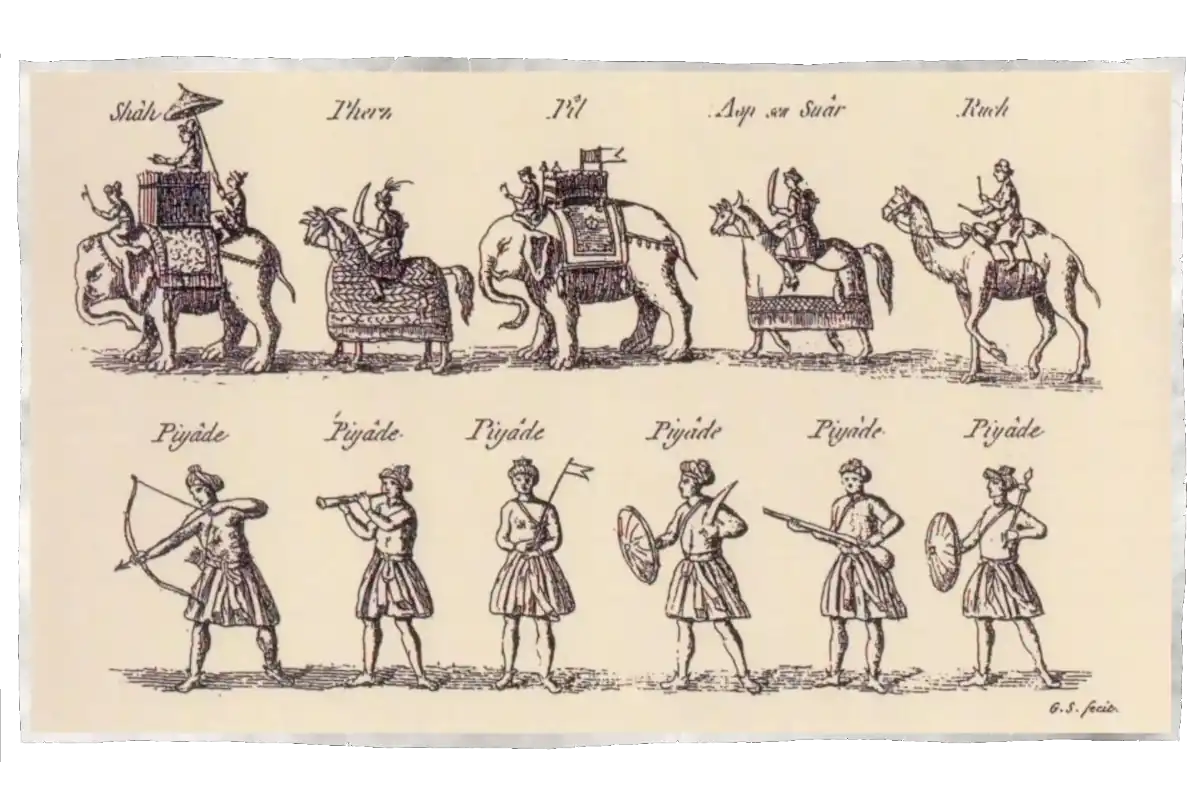
The exact origin of chess can no longer be determined, despite its high popularity. The first mentions of the game found about 600 years AD. Chr. in the north of India. It is highly probable that chess developed from the game "Chaturanga", which was played in India at that time and meant something like "Four Elements" or "Four Parts". The game referred to the four units of the Indian armies: infantry, cavalry, chariots and elephants, which, as in chess, were drawn on a playing field with 64 squares. However, since the exact rules have not been preserved, the connection between the games is unfortunately not provable and can only be inferred very vaguely. Moreover, it is also assumed that the term "Chaturanga" in many historical records refers to the Indian army itself rather than the military-style board game. However, it is ruled out that the game has a single originator, since it has many cultural as well as temporally widely divergent historical references in addition to its high complexity.

Illustration of Shatranj pieces in the book Mandragorias seu Historia shahiludii by Thomas Hyde in the year 1694

Early Shatranj game pieces

Illustration of Shatranj pieces in the book "Mandragorias, seu, Historia shahiludii"
by Thomas Hyde in the year 1694

Around the middle of the 6th century, the Indian king Divsaram gave a war game called "Chatrang" as a gift to the Persian court. It is believed that "Chatrang" was a slightly modified version of "Chaturanga", as the game pieces had other designations: king, commander, elephant, horse and foot soldier. The game was very popular and its popularity was most likely promoted by the then ruling and quite culturally interested King Chosraus I, which also gave the game a high social status. Thus, players who mastered it were highly respected, and several writings have survived that mention the game along with other culturally established games of the time. The terms "chess" and "mate" also have their origins in the Persian language. "Chess" translates to "Shah," which means "king." "Mate", on the other hand, can be interpreted from the Persian "Mat", as "helpless, beaten or abandoned". "Checkmate" in the context of the game therefore means something like "Shah Mat": "The king is abandoned to his fate". The paraphrase refers to the rule that the king is not directly defeated, but the game ends as soon as he gets into a hopeless situation.

Chatrang Schatrandsch gaming pieces 12th century iran

Chess set, 12th century, Iran

A well-preserved 12th century chess set from Nishapur, Iran, on display at the Metropolitan Museum of Art. The pieces had different shapes at that time. King and queen were represented with thrones of different sizes. The bishop was an elephant with two tusks, the knight was represented as a horse, as it is today, and the rook had a V-shaped piece. The pawns were represented as hemispheres with knobs at the top.
In the first half of the 7th century, the Arabs conquered the Sassanid Empire and came into contact with the game now called "Shatrandsch" due to linguistic modification. As in Persia, the game gained great popularity in the Arab world and became a cultural asset. Thus Arabic records report for the first time of famous players such as: al-Adli, ar-Razi or Mawardi and professional players, who occupied themselves extensively with the art of play. At that time, entire treatises on opening strategies, endgame positions, tactics and even the first links to mathematics were written down. Since, moreover, the rules of "Shatrandsch" have survived and these show an obvious similarity to the later game of chess, the Arabian game variant is, in view of its historical origin, the clearest link to the Indian origin of chess.


The wheat grain legend is also attributed to the Arabic region while confirming the connection to India. According to this legend, there was once the Indian ruler Shihram, who did not live up to his position as ruler and tyrannized his people. The Brahmin Sissa then created a game for the king to show him what duties and responsibilities all members of the nation have and how he should rule them. Impressed by the game, King Shihram slowly became aware of his responsibility and had the game spread in all directions. In return for the game and the lesson, the king granted Sissa a wish. He asked for an ever-doubling amount of wheat grains from chess square to chess square, starting with a single grain. The king was astonished at the supposed modesty and asked the mathematician and the overseer of the granary to procure the required quantity. Unfortunately, this was not possible, since the quantity was more than 18 trillion grains of wheat, or 730 billion tons. This was to make the king once again aware of the complexity size of his leadership responsibility. The originators of the legend are most likely the poet as-Sabhādī, who came from Baghdad, and the biographer Ibn Challikān, who came from Erbil.


Until the 9th century Baghdad developed more and more into the cultural center of Islam and was the destination of many travelers and the starting point of countless trade routes. Trade caravans brought the Persian chess variant across the Asian region to Japan and via more northern routes of Constantinople to Russia. Via the Berber tribes of North Africa, chess reached Spain, where the highly gifted and very famous musician of the time, Abul-Hasan Alí Ibn Nafí, born in Iraq and sent to Andalusia by the Caliph because of his talents, further cultivated the game and promoted its fame.

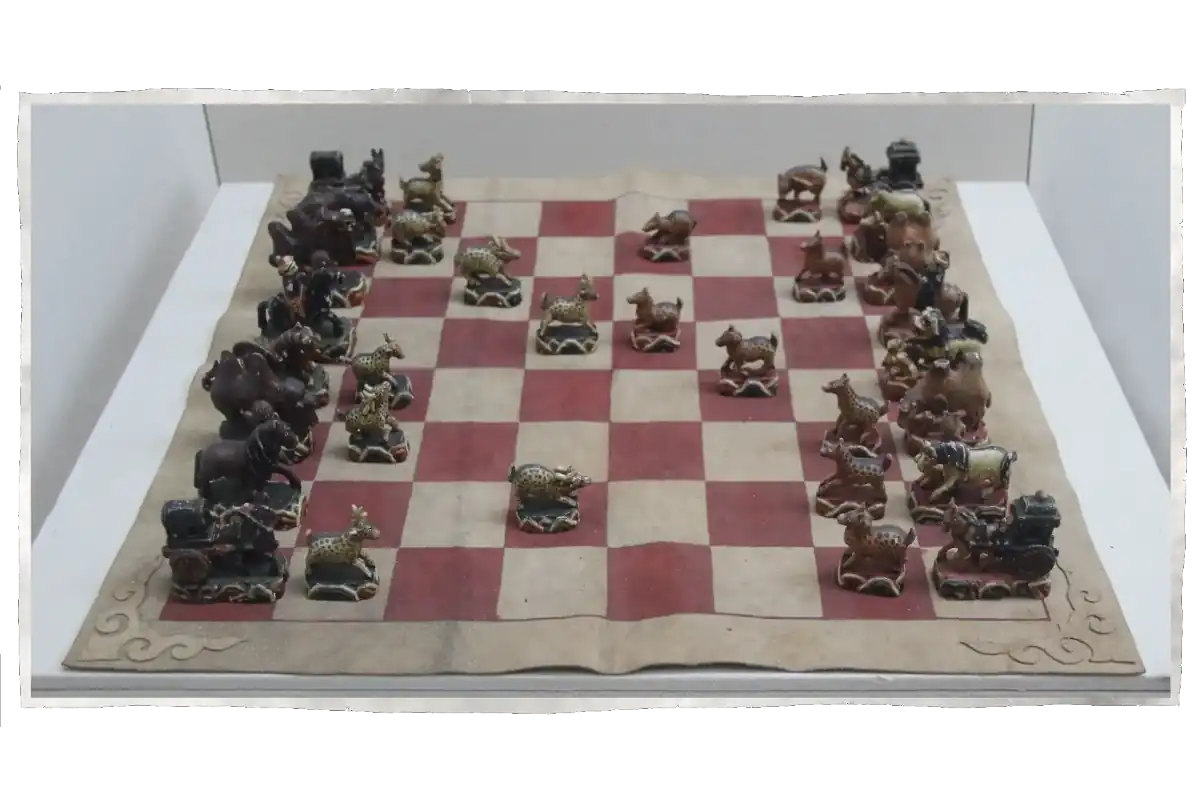
A Monglian chess set from the Qing dynasty

Mongol chess set, Qing dynasty

A Monglian chess set from the Qing dynasty. The rules are very similar to international chess, although the pieces have different shapes. The game is called Shatar in Mongolia, another game variant with 10 x 10 boards is called Hiashatar.
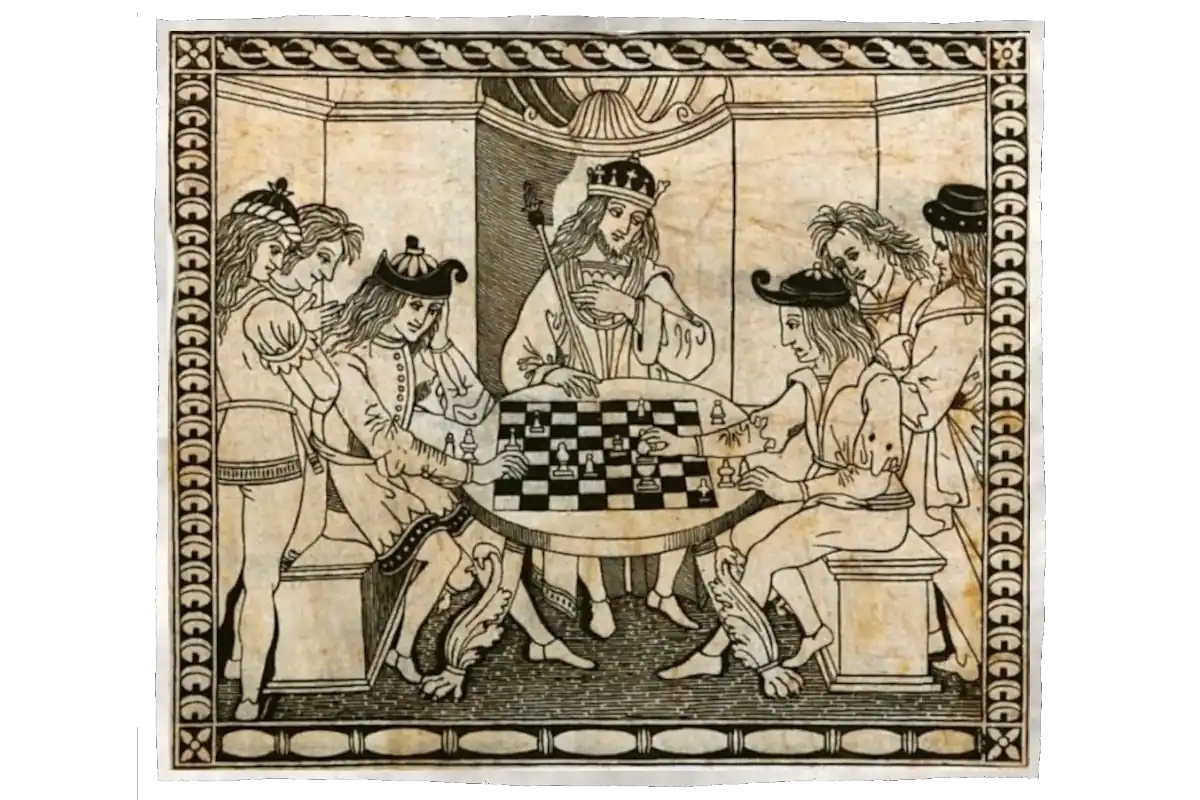
By the 13th century, the game had spread further to France, Italy and as far as Iceland. It was also during this period that the still well-known player openings named after their countries of origin were created. Despite objections and repeated prohibitions by the church on the grounds that chess was similar to gambling and would distract people from their duties, the game prevailed. As in the centuries before, the prestige of chess increased throughout Europe and was even elevated to one of the seven knightly virtues. Thus, in 1330, the Dominican Jacobus de Cessolis wrote a detailed interpretation of chess in his work "Liber de moribus hominum et officiis nobilium ac popularium super ludo scacchorum" (Translated: A book on the character of men and the duties of the nobility and common people in playing chess), referring to the roles and duties in society depicted through the game pieces. Because of the socially critical traits and the emphasis on solidarity over hierarchy, the work was very popular and one of the most circulated in the Middle Ages. In 1473, the first printed edition was even published in Utrecht.

The illustration of the chess game by the Dominican Jacobus de Cessolis in his book A Book on the Character of Men and the Duties of the Nobility and the Common People at Chess from the year 1473

The reputation of chess

The illustration of the chess game by the Dominican Jacobus de Cessolis in his book: "A Book on the Character of Men and the Duties of the Nobility and the Common People at Chess", 1473.
By the end of the 15th century, significant rule changes took place that made chess what it is today. The pawns got their double move and their transformation at the end of the board, while the bishop as well as the queen were allowed to move unlimitedly in their directions of movement. The queen in particular thus became the most powerful piece on the board, although the reasons for the strengthening of its power are not precisely documented. However, there are several assumptions that can be traced back to historical figures. For example, strong queens came to power in the Middle Ages, including Eleanor of Aquitaine, Blanka of Castile, and especially Isabella I, who exerted a high political influence on the course of history. The cultural anchoring of the Virgin Mary may also have influenced the rule change. In addition, long before the rule change, the importance of a queen to the king was romantically considered essential for survival. If the king were to lose his queen or his great love, there would be nothing of value left for him on the board. The new position of the queen in chess opened up completely new tactical and strategic possibilities, with which first the European and later players worldwide tried to contend with each other.


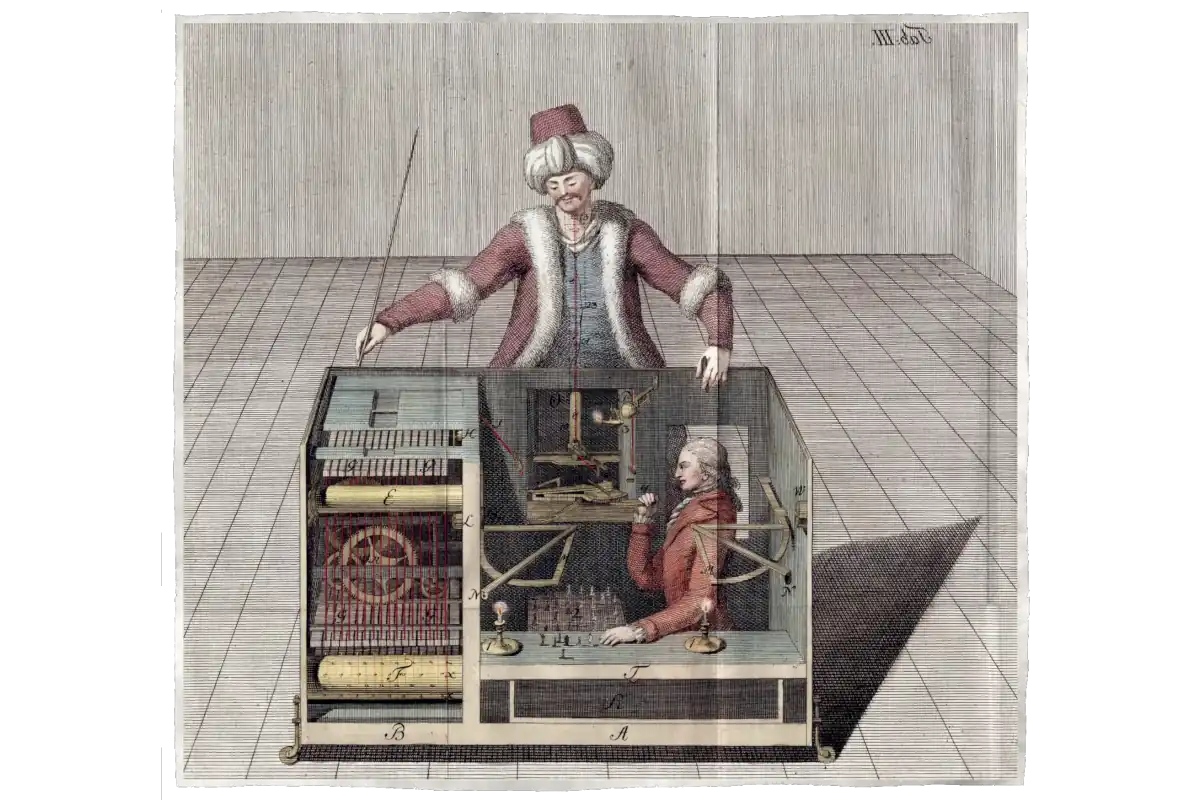
Until the 18th century, the Italians held a dominant position in chess and tactical literature, until the chess scene in France produced renowned players and became the European chess center. In particular, the "Café de la Régence" was the meeting place of many top players such as Paul Morphy, José Raúl Capablanca and Pierre Charles Fournier de Saint-Amant. Even celebrities like Napoleon Bonaparte, Karl Marx and Friedrich Engels moved their pieces across the field here. A small curiosity of that time was the "Mechanical Turk" built by Wolfgang von Kempelen. This was a chess robot which, in the guise of a man in Turkish clothes sitting in front of a box, could apparently move against real players without much deliberation and, in most cases, won. It was only a few decades later that the secret was revealed and it turned out that humans were hidden in the box and executed the moves via a complicated mechanism using the robot's hand movements. Even though the secret was not a big surprise, it was remarkable that such a complicated mechanism was created just for a trick and that players were found for the purpose who could internationally withstand and even defeat the challengers.

A cross-section of Joseph Friedrich Freiherr von Racknitz showing his conjectures about how the mechanical Turk works

Mechanical Turk

A cross-section of Joseph Friedrich Freiherr von Racknitz, showing his conjectures about how the mechanical Turk works. One of many illustrations by artists of the time with the purpose of revealing the mystery.
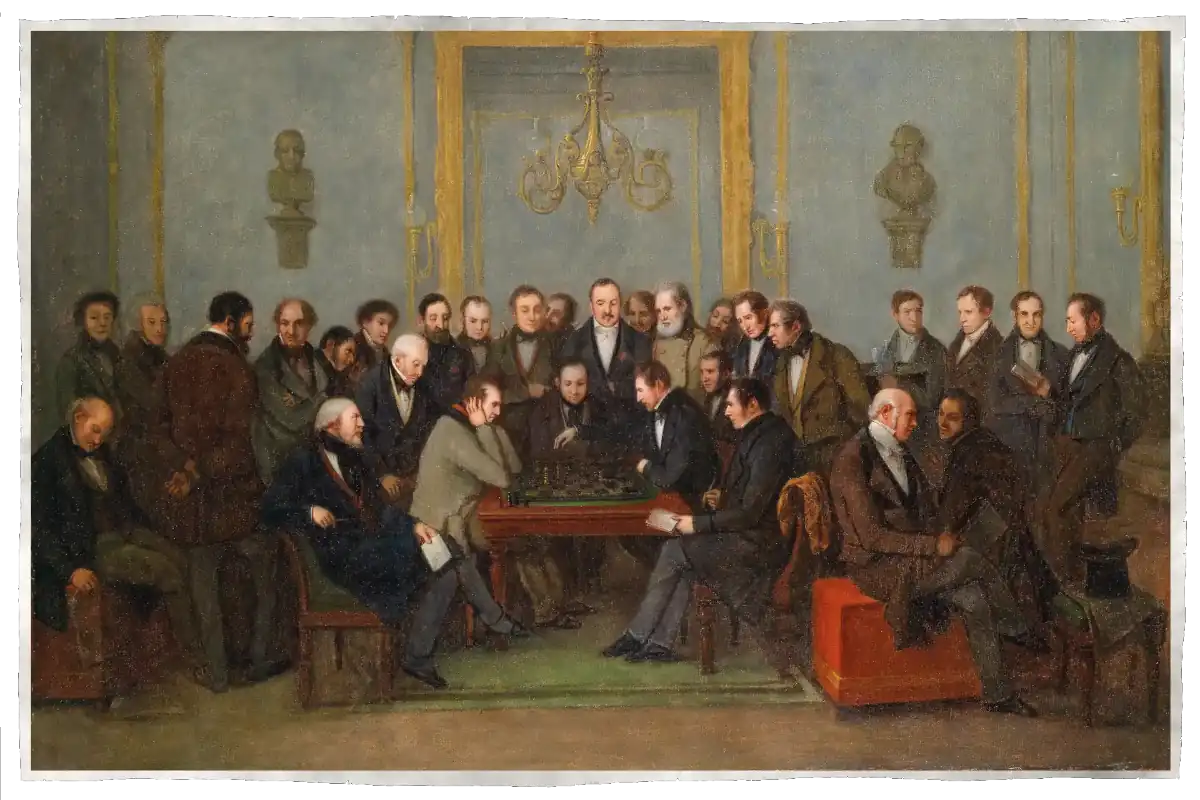
During the 19th century, chess continued its triumphant progress and became a favorite game of the citizens. Chess magazines regularly reported on new strategies and tactics while more and more competitions and tournaments were held. Around 1849, Nathaniel Cook created his famous piece designs, which were later officially adopted by FIDE and are now used to play chess worldwide. In order to deter imitators and promote the popularity of the pieces, he had the leading player of the time, Howard Staunton, sign the certificates of authenticity for the sets of pieces and even named the pieces after him: the Staunton pieces. In addition, the World Chess Championship was held for the first time, which Wilhelm Steinitz won against Johannes Hermann Zukertort in 1886. He kept his crown until Emanuel Lasker took the title from him in 1894, defending it in a record time that is still valid today. It was not until 1921, 27 years after his victory over Steinitz, that he lost to José Raúl Capablanca in the World Championship match in Havana.

An illustration by Jean Henri Marlet shows a match between Howard Staunton and Pierre Charles Fournier Saint-Amant on December 16 in the year 1843

Staunton vs. Saint-Amant

An illustration by Jean Henri Marlet shows a match between Howard Staunton and Pierre Charles Fournier Saint-Amant on December 16, 1843.
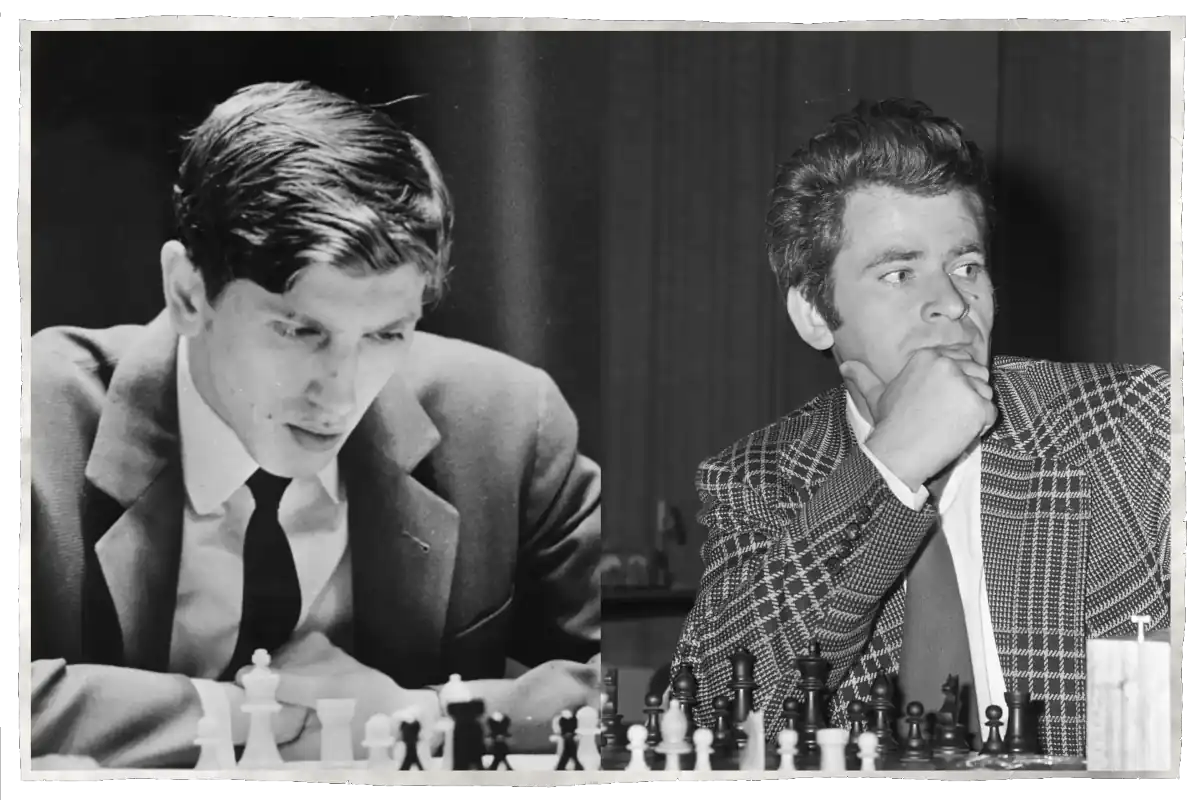
The professionalization of chess continued to rise in the 20th century. International tournaments were more frequently staged, chess leagues were founded and literature about chess compositions became more popular. The upswing in chess led, among other things, to the founding of the international chess federation "Fédération Internationale des Échecs" (FIDE), in 1924 and, from 1927, to the holding of the Chess Olympiads. Through state subsidies, Russia took a pioneering role in producing chess talent and dominated the competition from the 1950s onwards. Due to the high importance that chess gained in the wider public, a fierce competition formed between the Western and Eastern powers and culminated in the match of the century between Bobby Fischer and Boris Spassky in the final of the 1972 World Championship in Reykjavík. The match itself was exploited propagandistically as a proxy battle of the Cold War, with each side trying to prove that its respective system was superior. As a clash of two ideologies, Fischer represented capitalism and Spassky represented communism. Away from the game, the event was marked by Fischer's antics. Typical for him and favored by his high position in chess as the only worthy Western contender for the title, he acted out in an eccentric manner. For example, he successfully demanded an increase in the prize money, started the journey to the venue late and only after being asked to do so by Henry Kissinger himself, and after losing the second game he demanded that the match be played in a separate room. Fischer's manner, as always, had an intimidating and unsettling effect on his opponents, which also troubled Spassky. And after Fischer's victory in the third game, the tide finally turned in his favor. After a total of 21 games played between July 11 and August 31, the world champion was decided: Bobby Fischer defeated Boris Spassky. The naming of the event as the game of the century actually fulfilled the expectations of the worldwide audience at the time. Both players performed the final at the height of their skills and offered the world a drama that left nothing to be desired. The game of chess gained a lively following as a result of this match and was able to increase its popularity once again, although the accompanying political circumstances were less beneficial to its reputation.

Bobby Fischer and Boris Spassky

The match of the century

Bobby Fischer, amid great media hype, defeated Boris Spassky and decided the "cold" proxy war for the West. Both opponents played at the top level and fulfilled the worldwide expectations for the "match of the century".

Towards the end of the century, a battle between man and machine proved to be more fascinating than the political conflict. The reigning world champion Garry Kasparov, skilled in competing against chess computers and confident that he would never be beaten by one, competed in 1996 against Deep Blue, a chess computer developed by IBM. Amid great media interest, Deep Blue won the first game, but lost three more and managed only two draws. Regardless of the defeat for the computer, the main focus was on the first game won, which demonstrated that a computer could beat the world champion. With this insight, IBM equipped Deep Blue with even more powerful hardware and optimized the software. In 1997, just one year later, Deep Blue beat Garri Kasparov in six games under tournament conditions. Kasparov expressed anger at his defeat and accused IBM of helping the computer. Only 20 years later did he revise this statement and confirm that he had not been cheated.


The 21st century offered chess a worldwide breakthrough with the advent of the Internet, allowing anyone interested from anywhere in the world to play chess games around the globe without much effort. Providers of chess portals also made it possible to learn the game in a very short time and also to gain a comprehensive and - at least in comparison with the time before the Internet - advanced understanding of tactics and strategies. It also produced a number of great chess players. For example, Vladimir Kramnik and Viswanathan Anand dominated the chess world at the beginning of the century, until 2013 when chess prodigy Magnus Carlsen set new standards. With the outbreak of the Corona pandemic in the early 2020s, the popularity of chess increased once again, albeit from less fortunate circumstances. This was due to output restrictions at the height of the pandemic, which had greatly increased demand for digital entertainment. However, coverage and entertainment formats also surged, creating celebrity figures on media portals that will carry chess's profile into the future with confidence.

Submit Withdrawal Request

Please fill out the following form to submit your withdrawal request.

EU Widerrufsbutton logo EU Withdrawal Button